
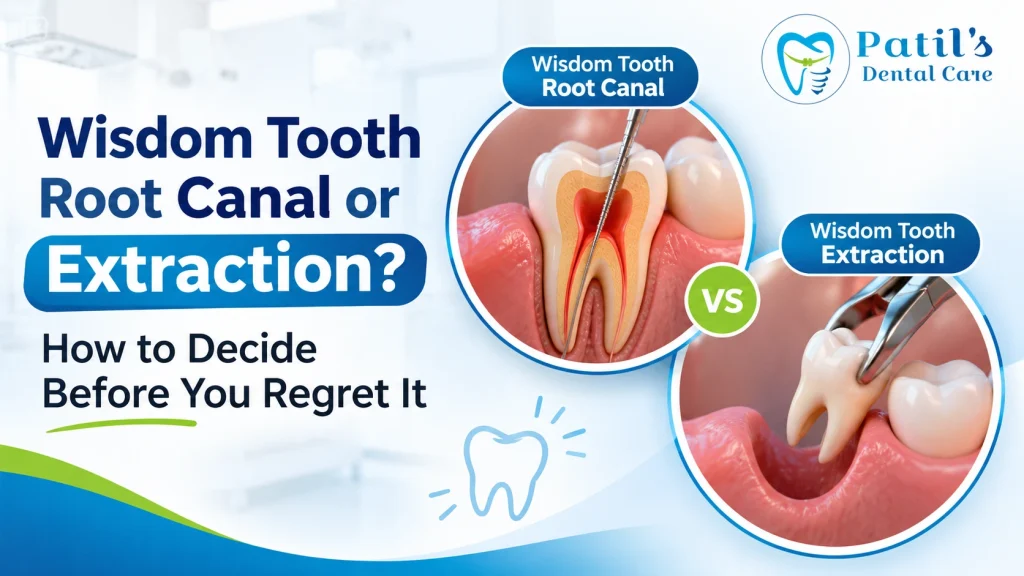
A throbbing wisdom tooth leaves you with two real choices: save the tooth with a root canal or remove it. For most people, wisdom tooth extraction is the safer and more predictable route, especially when the tooth is impacted, only partly erupted or too far back to clean. A wisdom tooth root canal works only when the tooth has erupted fully, can be reached with instruments, has enough healthy structure for a crown and meets a tooth in the opposite jaw when you chew.
The difficulty is that both options sound sensible when you are in pain, and it is easy to decide in a hurry. This guide explains how a wisdom tooth root canal and extraction work, what the risks look like, how long recovery takes and which questions to put to your dentist, so the choice you make this week still feels right a year from now.
Key takeaway: Choose a wisdom tooth root canal only if the tooth is accessible, restorable and useful. If it fails even one of those three tests, extraction usually serves you better.
What Is the Difference Between a Wisdom Tooth Root Canal and Extraction?
A wisdom tooth is the third molar, the last tooth to appear at the back of each jaw, usually between the late teens and the mid twenties. When it becomes infected, cracked or decayed, the dentist can either treat the inside of the tooth or remove the tooth altogether.
- Root canal treatment: The dentist removes the infected or inflamed pulp from inside the tooth, cleans and seals the canals and protects the tooth with a crown. You keep the natural tooth.
- Wisdom tooth extraction: The dentist removes the whole tooth. A simple extraction suits a tooth that has fully erupted. A surgical extraction suits a tooth that is impacted, meaning trapped under gum or bone.
Both treatments aim to end pain and stop infection. They differ in what stays behind. A wisdom tooth root canal leaves a tooth that needs care for life, while extraction removes the problem tooth for good.
Is a Wisdom Tooth Root Canal Possible?
Yes, but it is the exception. A wisdom tooth root canal makes sense when four conditions line up:
- Full eruption: The whole crown has come through the gum and the dentist can see it clearly.
- Easy access: You can open your mouth wide enough for instruments to reach every canal without strain.
- Restorable structure: Enough healthy tooth remains above the gumline to hold a filling or crown.
- Real function: The tooth meets a tooth in the opposite jaw and takes a share of the chewing load.
Missing even one of these usually tips the decision towards extraction. A wisdom tooth with no partner above or below keeps drifting and trapping food, so saving it adds very little.
Canal anatomy matters too. Third molars often have narrow, curved or fused canals, and published studies show lower success rates for back teeth with complex canals than for front teeth. Figures for wisdom teeth specifically are limited, so your dentist’s assessment of access and anatomy counts for more than any average.
Why Do Dentists Usually Recommend Wisdom Tooth Extraction?
Many wisdom teeth never behave like normal molars. Jaws often lack space, so the tooth grows at an angle, stays buried or breaks through only halfway. That position creates problems a root canal cannot fix.
- Impacted wisdom tooth: A tooth trapped under gum or bone cannot be cleaned properly and cannot be reached for a wisdom tooth root canal.
- Partial eruption: A flap of gum over the tooth traps food and bacteria, which can cause repeated infection of the surrounding gum, known as pericoronitis.
- Decay below the gumline: A tooth that has broken down this far cannot hold a crown.
- Damage to the neighbouring tooth: Pressure or decay can spread to the second molar in front, which is far more important to protect.
- Cysts or recurring infection: Removal clears these more reliably than treating the tooth from inside.
In each of these situations a wisdom tooth root canal would calm the symptoms for a while and leave the cause in place. Wisdom tooth extraction removes the cause. A surgical extraction is normally done under local anaesthesia, so you feel pressure but not pain.
How Is a Wisdom Tooth Root Canal Done?
Root canal treatment (RCT) on a back tooth usually takes one to three visits. The steps run in this order:
- Assessment: Digital X-rays show the canal shape, the bone around the root and the condition of the crown.
- Numbing: Local anaesthesia keeps the tooth comfortable throughout.
- Cleaning: The dentist opens the tooth, removes the infected pulp and shapes the canals. Rotary endodontic instruments shorten treatment time and clean the canals with more precision than hand files alone.
- Sealing: The canals are filled and sealed so bacteria cannot return.
- Restoration: A crown protects the tooth, because a root-filled back tooth fractures more easily.
This work falls under endodontics, the branch of dentistry that treats diseases of the dental pulp. If an earlier root canal has failed, a second attempt called Re-RCT cleans and reseals the canals again. On a wisdom tooth, access is already difficult, so dentists often weigh extraction before choosing Re-RCT.
Studies in endodontic journals report root canal success rates of roughly 86% to 98%, depending on the tooth and the case (Industry estimate; see References). Success also depends on the final restoration. A root canal without a sealed crown or filling is more likely to fail.
What Happens During Wisdom Tooth Extraction?
Dentists carry out wisdom tooth extraction as a routine procedure, and the steps follow the same principles as any tooth extraction, with extra care for depth and angle.
For a fully erupted tooth, a simple extraction is enough: the dentist loosens the tooth and lifts it out. A tooth that has not fully emerged needs a surgical extraction. The dentist makes a small cut in the gum, removes a little bone if needed and sometimes divides the tooth into pieces so it comes out through a smaller opening. This is the usual path for an impacted wisdom tooth.
Both versions of wisdom tooth extraction are done under local anaesthesia.
Wisdom Tooth Root Canal vs Extraction: How Do They Compare?
- Natural tooth: A wisdom tooth root canal keeps the tooth. Extraction removes it, though a missing wisdom tooth rarely affects chewing.
- Technical difficulty: A wisdom tooth root canal is demanding because the canals are often curved. Extraction ranges from simple to surgical depending on the angle and depth of the tooth.
- Visits: A root canal usually needs one to three visits plus a crown. Extraction is usually one visit followed by a review.
- Recovery: A root-treated tooth may feel tender when chewing for a few days. An extraction site needs one to two weeks for the gum to close.
- Main risks: A wisdom tooth root canal can fail through missed canals, reinfection or a cracked tooth. Extraction can lead to dry socket or infection.
- Future problems: A root-treated tooth can still decay, crack or develop gum disease. An extracted tooth cannot.
- Upkeep: A root-treated tooth needs a crown and regular check-ups. An extraction site needs only routine care once healed.
Wisdom Tooth Root Canal vs Extraction: Pain and Recovery Time
Neither a root canal nor wisdom tooth extraction should hurt while it is happening, because local anaesthesia numbs the area. The difference shows up afterwards.
- After a root canal: The tooth may feel tender when you bite for a few days. Pain relief advised by your dentist usually covers it.
- After wisdom tooth extraction: Swelling usually peaks around the second or third day, and many people return to routine activity within three to seven days. The gum takes one to two weeks to close, and the bone beneath keeps remodelling for several months.
Dry socket is the complication people fear most after wisdom tooth extraction. It happens when the blood clot in the socket is lost early, leaving bone exposed and causing throbbing pain a few days later. Reported rates run from roughly 1% to 5% of extractions overall and rise after surgical removal of lower wisdom teeth (Industry estimate; see References). Avoid spitting hard, drinking through a straw and smoking while the socket heals. Call your dentist if the pain grows worse after the third day instead of easing.
What Are the Risks of a Wisdom Tooth Root Canal and Extraction?
A wisdom tooth root canal carries these risks:
- Missed canals: Narrow or curved canals at the back of the mouth are hard to find and clean fully.
- Reinfection: Bacteria that remain in an unsealed canal can bring the infection back.
- Fracture: A tooth without a protective crown can crack under chewing force.
- Delayed restoration: Leaving the tooth without a permanent crown for long raises the chance of failure.
Wisdom tooth extraction carries these risks:
- Dry socket: Described above, it is treated by cleaning the socket and placing a medicated dressing.
- Infection: Rare when aftercare is followed, but possible.
- Temporary numbness: The nerve that supplies the lower lip and chin runs close to lower wisdom teeth, so brief numbness can occur and usually settles over time.
- Sinus involvement: Upper wisdom teeth sit near the sinus, and a small opening can occasionally form.
What Does the Dentist Check Before Advising a Wisdom Tooth Root Canal or Extraction?
The recommendation rests on a handful of findings:
- Digital X-rays: Root shape, canal anatomy, bone loss and the angle of the tooth.
- Clinical examination: Gum condition, mouth opening, tooth structure above the gumline and signs of infection.
- Bite: Whether a tooth in the opposite jaw meets the wisdom tooth.
- Medical history: Conditions or medicines that affect healing or the choice of anaesthesia.
How Do You Decide Before You Regret It?
Put these seven questions to your dentist after the examination and X-ray:
- Is the tooth fully erupted?
- Can every canal be reached comfortably?
- Is there enough healthy tooth above the gumline to hold a crown?
- Does the tooth have an opposing tooth to chew against?
- Have I had repeated gum infections around it?
- Is the tooth pressing on or damaging the second molar?
- What is the realistic outlook for this tooth and what is the plan if the wisdom tooth root canal fails?
If the answers are no to questions 1 to 4 or yes to questions 5 and 6, extraction is usually the more sensible option. If the tooth is healthy, accessible and working, saving it can be reasonable.
Common Mistakes That Lead to Regret
- Choosing a wisdom tooth root canal only to avoid surgery: A saved tooth that keeps failing means more treatment later, not less.
- Skipping the crown: A root-filled back tooth without a crown is prone to cracking.
- Waiting for the pain to pass: Pain that eases on its own does not always mean the problem has gone, because infection can continue silently.
- Relying on antibiotics alone: Antibiotics may settle swelling but they do not remove infected pulp or an impacted tooth.
- Deciding without imaging: A tooth cannot be judged by how it looks in the mirror. X-rays show root shape, bone and position.
- Ignoring warning signs of spreading infection: Facial swelling, fever or trouble swallowing or opening the mouth need urgent dental or medical attention.
Do You Need a Replacement After Wisdom Tooth Extraction?
Usually not. Most people chew comfortably without third molars, so the gap is left alone. The picture changes when a wisdom tooth was doing real work, for instance because the neighbouring second molar is already missing and the wisdom tooth is the last tooth left to chew with. In that case the dentist may discuss crowns and bridges or dental implants. Implants use titanium posts, and when the jawbone is thin a bone graft or a sinus lift in the upper jaw may be needed first.
How Does Patil’s Dental Care Handle These Treatments?
Patil’s Dental Care is a dental clinic set up for both routine work and advanced procedures. The clinic has digital X-ray facilities and implant surgical equipment. Before any procedure, Dr. Patil and the team explain what it involves, how long it will take, what the patient will feel and what to expect during recovery.
Dr. Mangesh Kadu Patil completed his BDS at Maharashtra University of Health Sciences, Nashik in 2011 and his MDS in Orthodontics and Dentofacial Orthopaedics at BBDU, Lucknow in 2014. He is a member of the Indian Orthodontic Society and a trained implantologist. The treatments he performs personally include complex tooth extractions, dental implant placement, bone grafting and sinus lift procedures.
On the treatments covered in this article, the clinic offers root canal treatment for first-time cases and Re-RCT for earlier root canals that failed, using rotary endodontic instruments. It also performs wisdom tooth extraction, including surgical removal of an impacted wisdom tooth, under local anaesthesia, and describes it as a common procedure.
Regular check-ups every six months under preventive dentistry help catch decay and gum trouble around wisdom teeth before they reach this stage.
Frequently Asked Questions About Wisdom Tooth Root Canal and Extraction
Can an impacted wisdom tooth have a root canal?
Rarely. An impacted tooth sits under gum or bone, so the dentist cannot reach the canals or seal the tooth properly. Surgical extraction is the standard treatment for an impacted wisdom tooth that is infected or causing damage.
Is a wisdom tooth root canal better than extraction?
It depends on the tooth. Wisdom tooth extraction suits teeth that are impacted, hard to reach or decayed below the gumline. A wisdom tooth root canal suits only a fully erupted, accessible, restorable tooth that works against an opposing tooth. Your dentist decides after examination and X-ray.
Is a wisdom tooth root canal painful?
The procedure itself is not painful because the area is numbed with local anaesthesia. Mild tenderness when biting for a few days afterwards is common. Pain that stays severe or grows worse needs a review.
How long does recovery take after wisdom tooth extraction?
Swelling usually peaks around day two or three, and many people resume routine activity within three to seven days. The gum generally closes in one to two weeks. The bone underneath continues to heal for several months.
What is dry socket and how can I lower the risk?
Dry socket occurs when the blood clot leaves the socket too early, exposing bone and causing throbbing pain a few days after extraction. Follow the aftercare advice: avoid spitting, straws and smoking, keep the area clean as instructed and report worsening pain.
Can a wisdom tooth infection go away without treatment?
Symptoms may settle for a while, but the cause usually remains. A partly erupted tooth keeps trapping food and bacteria, so infection tends to return. Antibiotics may calm swelling but do not remove the source.
Does a missing wisdom tooth affect chewing?
Usually not. Most people chew comfortably with their other molars.
What happens if a wisdom tooth root canal fails?
The dentist reviews the tooth with X-rays. Options include Re-RCT to clean and reseal the canals or extraction. Because access to a wisdom tooth is limited, extraction is often the more practical choice after a failure.
When is a wisdom tooth problem urgent?
Facial swelling that spreads, fever, difficulty swallowing or trouble opening the mouth point to a spreading infection. These signs need prompt dental or medical attention.
The Bottom Line
A wisdom tooth root canal is justified only when the tooth is fully erupted, reachable, restorable and useful. Everything else points to extraction. The regret people describe usually comes from delay, from skipping the crown or from saving a tooth that was never a good candidate. A clinical examination and X-ray remove most of the guesswork and give you a clear reason behind whichever option your dentist advises.

Dr. Mangesh Kadu Patil
BDS, MDS - Orthodontics and Dentofacial Orthopaedics, Orthodontist
9+ Years Experience Overall (6+ years as specialist)
Dr. Mangesh Kadu Patil is a highly skilled Orthodontist in Wakad, Pune, with 9 years of experience in the field. He practices at Patil's Dental Care in Wakad, Pune, where he offers expert orthodontic treatments. Dr. Patil completed his BDS from Maharashtra University of Health Sciences, Nashik in 2011, followed by an MDS in Orthodontics and Dentofacial Orthopaedics from BBDU, Lucknow in 2014. He is an active member of the Indian Orthodontic Society. Dr. Patil specializes in providing personalized, effective orthodontic care to enhance your smile and dental health.